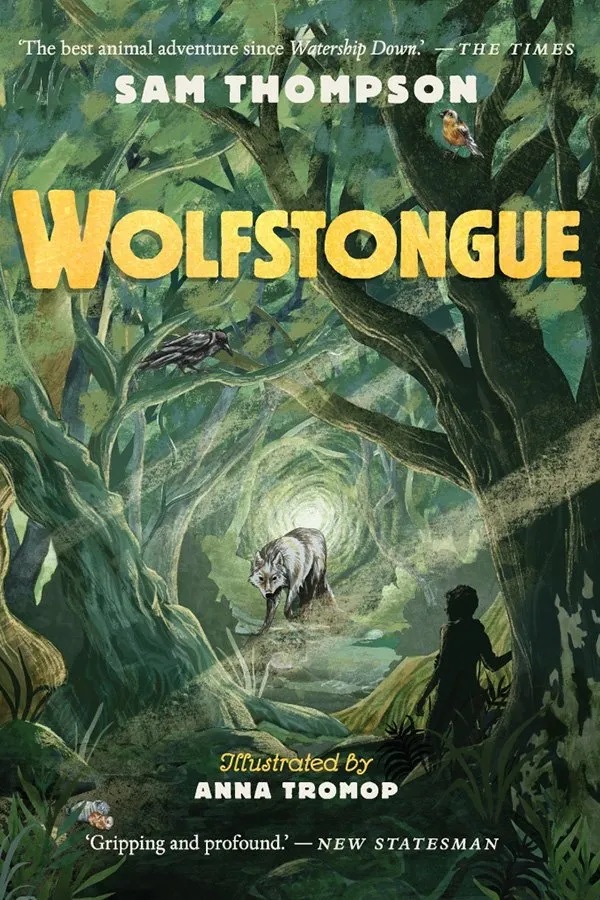
This month we were delighted to have a chat with author, Sam Thompson.
TPP: Why was it important to have a protagonist who struggles to speak?
ST: When I wrote the book, my son was around six years old and was having some speech difficulties. Seeing this made me think a lot about how strange and troublesome language can be, and how it can defeat and trap us as easily as it can help us to express ourselves. That’s what Wolfstongue is about.
TPP: What made you decide to make wolves central to the story?
ST: Partly the fact that my children were big wolf fans when I wrote it! And wolves are such strong symbols for us humans – we can never decide if they’re monsters we should fear, or if we’re just like them, or both.
TPP: Was it challenging to write for the animals in the story?
ST: Sure, but they were one of the most fun parts as well. The animals come from old folklore – Isengrim the Wolf, Reynard the Fox – so writing them was like encountering beings who had existed for a long time already.
TPP: Have you always been a writer?
ST: I’ve been writing stories since I was small, but I tell myself that ‘being a writer’ is an identity earned on a daily basis – by doing some writing.
TPP: What is your favourite part of the writing process?
ST: The moment when it starts behaving like a living thing – when it becomes clear that the language has its own agenda and all the writer can do is help it along.
TPP: Wolfstongue is the first part of a trilogy, did you plan for this when you first wrote Wolfstongue?
ST: No, I thought it was going to be a stand-alone book when I wrote it. My young protagonist Silas had been on his adventure, discovering the hidden world of the Forest, helping the wolves escape from the city of the foxes and coming to terms with his own speech difficulties in the process, and I thought there would be no more of his story to tell. But once it was finished, I realized I was wrong – and over the next two books, the story of the wolves and the foxes went on a generation into the future and into another reality.
TPP: Did you write when you were a child?
ST: Yes, though I wasn’t even very aware that I was doing it. I loved reading, and writing stories (or drawing comics or maps or whatever else) felt like an obvious continuation of what was good about reading – it was a way of responding to the books that were important to me, and of somehow getting closer to them. When I thought of all the books and stories in the world, I felt that something wonderful was going on, and I wanted to be part of it in any small way I could. I still feel the same.
TPP: What was your favourite subject at school?
ST: Probably Art to begin with. Like writing, drawing always felt like a very natural activity and a happy way to spend any amount of time. Later on, English was another favourite, because I liked reading and I found that I did also enjoy writing *about* books. I don’t think you need to like English to be a good reader, though, or a good writer.
TPP: Did you ever consider a different career?
ST: I think I considered many different careers with varying degrees of seriousness! And I do have another career, teaching at a university, which is an activity quite different from writing. The fact is that writing books isn’t really a career at all. A very, very small fraction of writers make lots of money from it, but they are so rare that they represent a statistical anomaly, not a career path. Most writers don’t make enough money from writing to buy groceries, so writing is something you do as a vocation, not as a ‘career’. This is not necessarily a bad thing.
TPP: Do you think writing is a beneficial pursuit for everyone?
ST: I wouldn’t want to speak for everyone, but I’ve been writing for decades and I’m still learning the ways it helps me. Spending a few minutes writing in a notebook about your day is a way of communicating with yourself, and it can really help you get your balance back when you’re having a tough time. Telling a story with honesty and care is a way of stepping away from all the big, loud stories of our culture, media and politics that are continually trying to overwhelm us and finding a perspective of your own. That is a beneficial pursuit.
TPP: What would you advise anyone who wants to pursue a career as an author?
ST: I would want them to read my answer to question nine above – but I would also want them to understand that this is not a counsel of despair. I’m not saying don’t pursue writing. In a way it’s the opposite: once you understand that it’s not reasonable to measure your success as a writer by ‘career’ things like how much money you make, you’re free to decide what your true goals are. Every writer has to decide that for themselves, but it’s useful to remember that writing is not a career you pursue or a job that someone has to offer you. It’s a practice that will always be with you if you want it and will weave in and out of your life in the world.