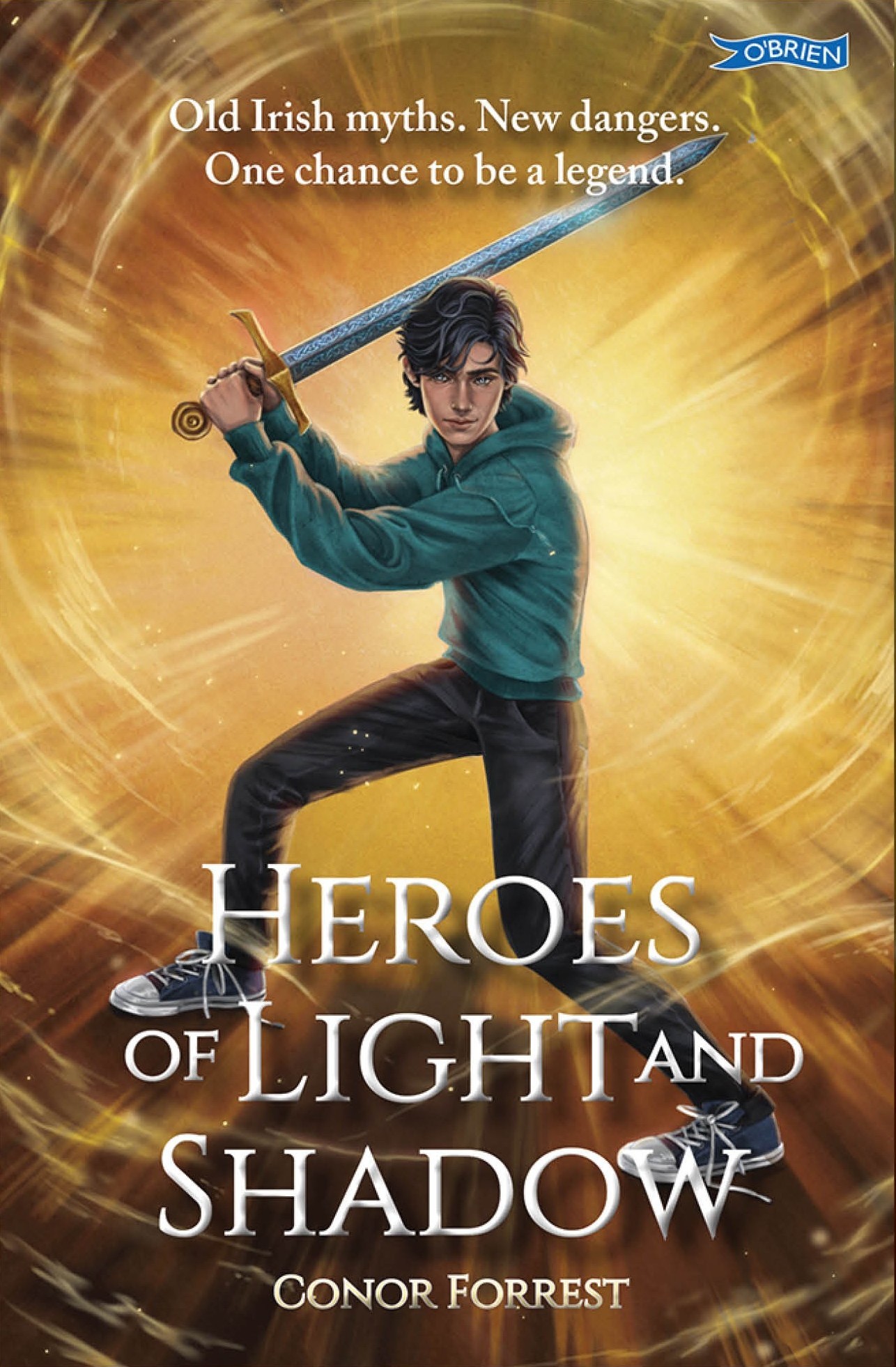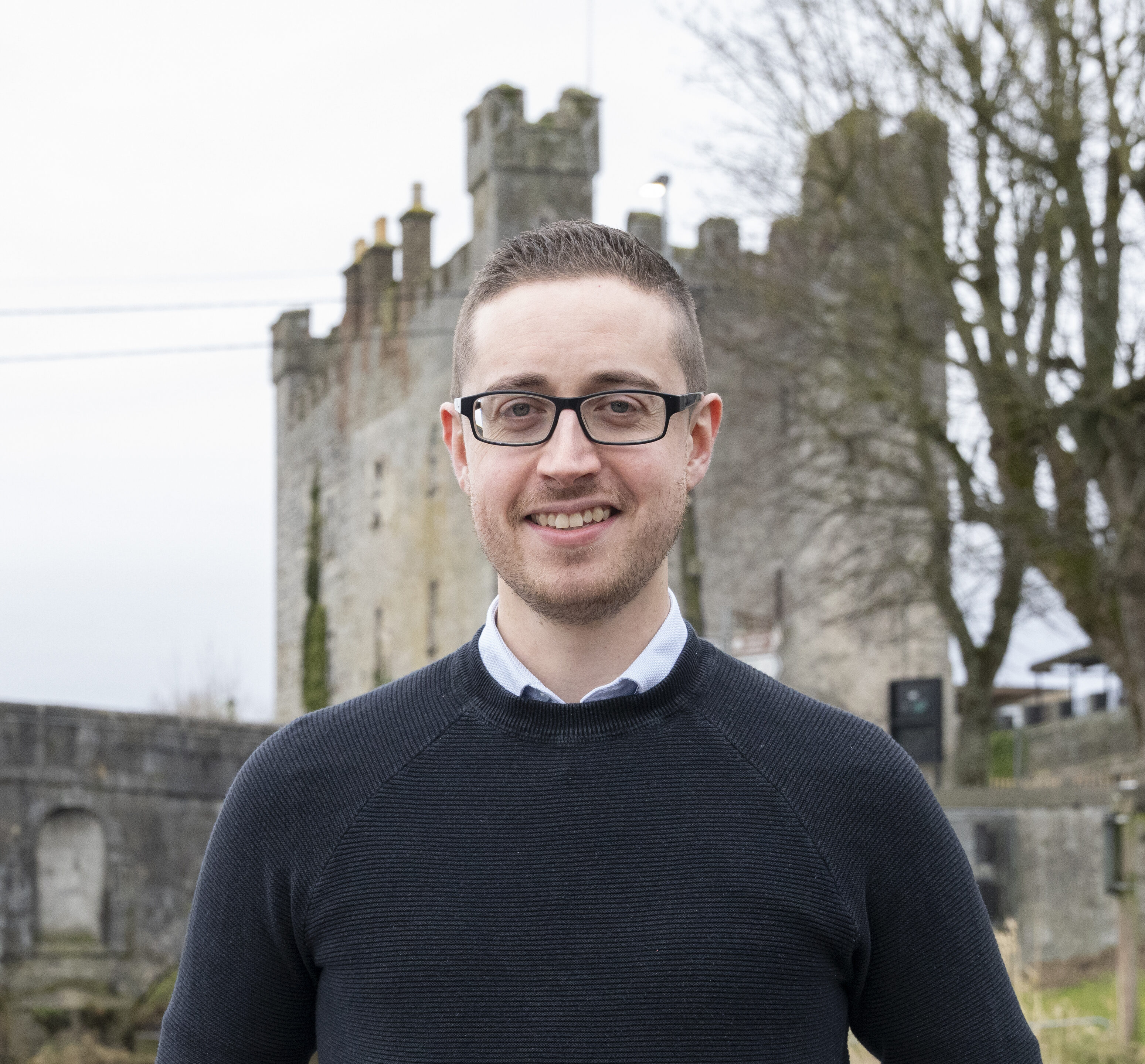
This month, to celebrate the release of his debut novel, Heroes of Light and Shadow, we were delighted to talk to debut author, Conor Forrest.
TPP: What was your favourite part about writing Heroes of Light and Shadow?
CF: There are so many to choose from! I did a lot of very enjoyable research into Irish mythology and folklore and I learned so much about stories, characters and locations I’d never heard of before. For example, I’d always had a vague notion of the links between my home county of Kildare and Fionn Mac Cumhaill and the Fianna, but it was only when digging through the myths and legends I discovered that Fionn had a huge fortress at The Hill of Allen. Rathcroghan over in County Roscommon was another ancient site I’d never heard of before and is now on my bucket list to explore – it’s a fascinating complex where one can (according to legend) access the Otherworld through Oweynagat or the Cave of the Cats. It was also the home of Queen Medb of Connacht, famed for starting the Cattle Raid of Cooley. I really hope Heroes of Light and Shadow inspires readersto learn more about Irish myths and legends.
TPP: Which character was the most fun to write?
CF: I had a blast writing Oisin Ryan, my young protagonist, and discovering this weird and wonderful world through his eyes. In many ways Oisin is an ordinary kid, but a curious one who, when faced with a situation that requires courage and bravery, tends to the rise to the occasion – how many 12-year-olds would visit a museum late at night to try and foil a robbery? As his uncle Fionn remarks: “Your father had the very same mix of curiosity and stubbornness. Got us into a tight spot more than once.” My second favourite to write was Fionn who is wonderfully irreverent and very unconcerned about danger – a recent review by Books for Keeps summed him up very well in my opinion, describing him as ‘wonderfully insouciant, and always ready with a wry comment or witticism, even as he’s knocking out the bad guys, a kind of magic James Bond if you like.’ High praise!
TPP: What do you think is so fascinating about museums?
CF: For me, museums are a fascinating portal to lost worlds, where history is brought to life in a very visceral way. I’ve been captivated by history and archaeology (the older the better) since I was a small child, thanks to my grandfather Andrew Forrest who was a great man for telling tales of ancient Egypt and other far-flung places, and who made some discoveries himself. In the early 1970s, on his farm in Kildare, he unearthed a medieval skull belonging to a man who had undergone trepanation (the oldest known surgical procedure, involving cutting a hole in the skull) and lived to tell the tale. Heroes of Light and Shadow begins at the National Museum of Ireland in Collins Barracks, Dublin because it’s one of my favourite museums. I’ve spent a lot of time here – when I worked nearby a number of years ago, I would often take a stroll down and wander the museum at lunchtime, taking in exhibits ranging from a stone chisel dating between 3800-2500BC and the first Irish coins struck by the Dublin Vikings to a greatcoat worn by Michael Collins. We’re blessed with some fantastic museums in Ireland like the Chester Beatty and Kilmainham Gaol in Dublin, Titanic Belfast, Cork City Gaol and much more. And I have to give a shout-out to the fantastic Shackleton Experience in my hometown of Athy, Co Kildare!
TPP: How did you become a writer?
CF: By accident! I’ve always loved books, since before I could read, a habit that was always encouraged and supported by my parents. I first started writing stories in primary school and discovered it was something I enjoyed, and I was always encouraged by teachers along the way in St. Laurence’s National School in Crookstown and then Coláiste Lorcáin in Castledermot. I had plenty of ideas for larger and longer stories over the years, though I always thought that writing a book would be simply out of reach. It was during my college years that I decided to just try my hand at it – I had no real idea what to do, so I simply opened a new Word document and started with the first word, the first sentence, the first paragraph, the first chapter. It snowballed from there and, after many months, I had a (very rough) first draft and a lot of valuable experience. I don’t have any professional training – I essentially learned on the job. If I can do it, anyone can!
TPP: Are you a full-time writer, or do you have another job as well?
CF: I’ve always had a day job alongside my writing – though I’d absolutely love to do this full-time. I’m currently working in the Public Service which is great in terms of flexibility and work-life balance, so I’ve got plenty of time in the evenings for writing. I mainly write on my PC at home, but I invested in a handy Bluetooth keyboard and stand for my phone and often use it at lunchtime to jot down various ideas that pop into my head during the day.
TPP: Do you have a favourite book of all time?
CF: That’s the toughest question of all! When I was growing up, I particularly loved reading books about fantastical worlds hidden just out of sight, and devoured series like Harry Potter, Artemis Fowl, Darren Shan, The Chronicles of Narnia, and Skulduggery Pleasant, which have all inspired my own writing in one way or another. The first Skulduggery Pleasant book by Derek Landy gripped me like few other books had – I hadn’t read anything with such a fascinating mix of magic, danger, humour, and brilliant characters. As an adult, I think my favourite book has to be Stephen King’s 11.22.63, the tale of an English teacher in 2011 who sets out on a mission to prevent the assassination of JFK. It’s utterly magnificent and completely immersive, one of those books that, when you’ve finished, you close and sit there in silence for some time. Honourable mention, for personal reasons, goes to a book called Worse Could Have Happened. It was written by my late grandfather Andrew and it’s an honest, funny and clever tale of his childhood in north Cork set against the backdrop of the Irish Free State. Having a tangible link on my bookshelf to a man I loved and greatly admired is priceless and brings back fond memories every time I see it.
TPP: How do you come up with ideas?
CF: I find that ideas tend to come organically rather than by force – for example, when I’m watching a film or reading a book and a particular scene or character or setting really grabs me, or reading something online or in a newspaper. My best ideas tend to just pop into my head – not least of all the inspiration behind Heroes of Light and Shadow. I had the bones of an interesting story when I was browsing Wikipedia one night in the early 2010s and I stumbled across an entry for the Tuatha Dé Danann. These were a supernatural, ancient race who arrived on Irish shores thousands of years ago and defeated the Fir Bolg and the Fomorians, before falling to the mortal Milesians and disappearing into the mounds and becoming the fairy folk of Ireland. As I read about these mythical people, a thought popped into my head – what if they had actually existed and were still around today? That was the tiny seed that would eventually – after a good deal of work – become Heroes of Light and Shadow.
TPP: Do you think it is important to plan what you’re going to write before you write it?
CF: Ultimately, I think it’s important to find what works best for you. There are plenty of great arguments out there in favour of plotting out your story in great detail before you begin, or ‘pantsing’ i.e. discovering the plot as you write it. I tend to fall somewhere between the two – I need some semblance of a structure to get going and help me find my way, but I find that my story and characters often take turns and make decisions I never expected, and that’s something I really enjoy. After I’ve got the general idea for a book, I create a Word document called ‘Chapter guide’ in which I jot down my ideas chapter by chapter. Some are quite detailed, others may be just a line or two, and many are blank – waiting to be discovered. There were many plot points and scenarios in Heroes of Light and Shadow that I stumbled across as the story unfolded or were the natural consequence of a character’s decisions.
TPP: Do you have a writing routine?
CF: All the advice I’ve read around writing routines is to try and create a daily goal, be it 250, 500, 1000 words or whatever. To be honest, when writing my first book I essentially wrote in spurts, when I had time or when inspiration struck – perhaps that’s why it took so many years to finish! As I look towards future projects, my goal is to start and maintain a habit of several hundred words each day and build from there. I’ve always been something of a night owl, so I tend to write better in the evenings/nighttime, and I often have music playing in the background – I find certain movie soundtracks (Hanz Zimmer, Thomas Newman and Alexandre Desplat are wonderful) can be very inspiring!
TPP: What is your favourite thing to do when you’re not writing?
CF: I have two young kids which makes for a very busy but enjoyable life! I love reading books and often have several on the go – I just finished The Lock-Keeper’s Wife by the wonderful John MacKenna and I’m currently engrossed in The Children of Gods and Fighting Men by Shauna Lawless. I love watching films too – I recently saw Project Hail Mary, adapted from the fantastic book by Andy Weir and a must-see on the big screen if you get the chance.
TPP: What has been the most exciting thing about getting your first novel published?
CF: Seeing the reaction from people, particularly young readers, has been fantastic. I first put pen to paper (or finger to keyboard) on what would become Heroes of Light and Shadow more than a decade ago, so for many years this book has existed only in my head and on my computer screen and, until relatively recently, I was the only person who knew the story and how it unfolded. Putting yourself and your work out into the world is a big step, but the reaction has been fantastic. It’s been so rewarding to see readers delve into this world I’ve created and enjoy its twists and turns, and express interest in where the story goes next!
TPP: What is your top tip for aspiring writers?
CF: Practice – put words on the page! There’s a quote attributed to Ray Bradbury that I like: “Quantity produces quality. If you only write a few things, you’re doomed. Write a lot. Read a lot. Keep going.” It’s easy (and enjoyable) to get bogged down in planning and plotting and researching and figuring out where you’re going, but the only way, in my experience, that you’ll learn and improve is by actually writing. And remember your first draft is just that – a first step. It doesn’t have to be perfect and publication-ready, but it does need to exist.